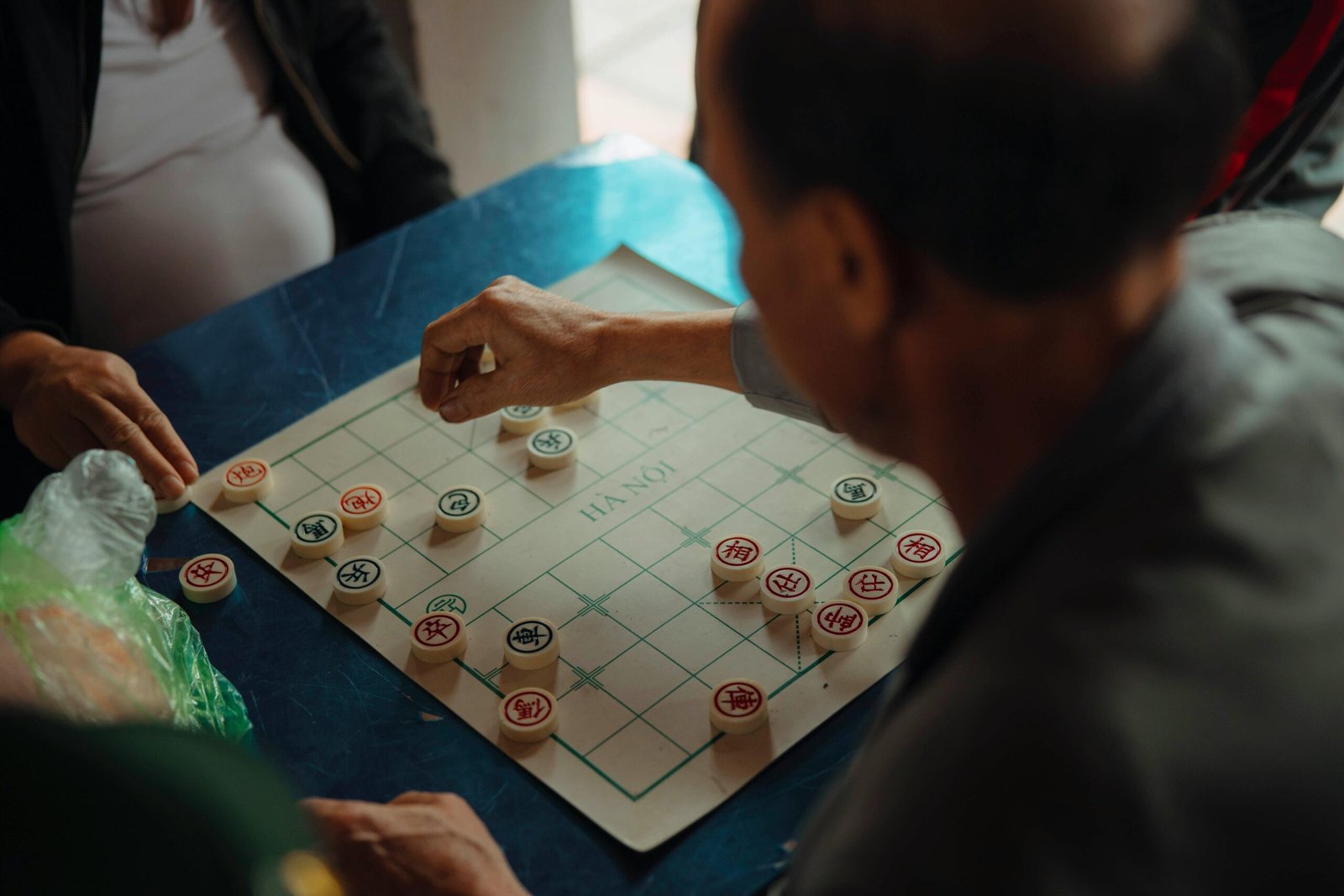
Two chairs, one table, and every decision your opponent makes is aimed directly at you. That is the appeal of two-player strategy games stripped down to their core. No alliances to lean on, no third player to absorb the blame when a plan falls apart, no negotiation phase where someone else brokers a deal that swings the game. Just two minds locked into a contest where every action carries real weight and every mistake is yours alone to own.
The two-player strategy space has grown enormously over the past decade as designers have realised that fewer seats at the table doesn’t mean less depth. The opposite tends to be true. With only one opponent to consider, games can be tuned to a level of precision that larger player counts rarely allow. Turns become faster, feedback loops become tighter, and the relationship between cause and effect becomes far easier to trace. That clarity is a large part of what makes dedicated two-player games so addictive. You can see exactly why you lost, which means you can figure out exactly how to win next time.
There is also a practical appeal that’s easy to overlook. Organising a game night for four or five people requires schedule juggling that borders on project management. Two-player games only need one other person and a spare half hour. That accessibility has driven a surge in demand, and publishers have responded with an increasingly deep catalogue of titles designed specifically for pairs. The seven games below represent the strongest options available right now, spanning everything from fifteen-minute trading duels to multi-hour war simulations that consume an entire afternoon.
1. 7 Wonders Duel
Antoine Bauza and Bruno Cathala rebuilt the civilisation-building card draft from the original 7 Wonders specifically for two players, and the result is arguably the tightest competitive game you can fit into thirty minutes. Cards are arranged in overlapping pyramid displays across three ages, some visible and some hidden. On each turn, a player picks an available card and either builds it into their civilisation, uses it to construct a Wonder, or discards it for coins. The simplicity of that choice is deceptive, because the consequences ripple outward in ways that aren’t always obvious until several turns later.
Three Ways to Win
The triple victory condition is what elevates Duel beyond a standard drafting game:
- Victory Points. The conventional route. Score the most points across all three ages through buildings, Wonders, and progress tokens.
- Military Supremacy. Push the conflict token far enough into your opponent’s territory and the game ends instantly, regardless of point totals.
- Scientific Supremacy. Collect six unique science symbols and trigger an immediate win before final scoring even happens.
That means tunnel-vision on a single strategy is a reliable way to lose. Ignoring an opponent’s creeping military column or quietly growing science collection can end the game out of nowhere, which forces both players into a constant balancing act between building their own engine and disrupting the other player’s plans. Even experienced players get caught off guard when they focus too heavily on one path and leave another undefended.
The Hidden Card Gamble
The face-down cards in each display add a layer of calculated risk to every pick, since taking one card might reveal something the opponent desperately needs. This creates a secondary game of information management that runs alongside the primary drafting decisions. Do you take the card that strengthens your position, or do you grab something purely to prevent your opponent from accessing it, even if it offers you nothing? That kind of dilemma shows up on nearly every turn, and it never stops being interesting.
The Pantheon expansion introduces mythological powers for experienced players who want an additional layer of complexity, though the base game alone sustains months of regular play without feeling stale. At roughly thirty minutes per session with minimal setup time, 7 Wonders Duel earns its spot at the top of this list through sheer replayability and the consistency of its strategic tension.
Order 7 Wonders Duel Here
2. Twilight Struggle
A card-driven area-control game set during the Cold War, with one player controlling the United States and the other the Soviet Union. Over ten rounds, both sides spread political influence across the globe, trigger historical events drawn from real Cold War incidents, and attempt to dominate without accidentally starting nuclear war. Twilight Struggle held the top spot on BoardGameGeek’s overall rankings for years, and its standing among two-player strategy enthusiasts remains formidable even as newer games enter the conversation.
Every Card Is a Painful Decision
The card system is the engine that makes everything work. Each card belongs to one of three affiliations: US, USSR, or neutral. Players must play cards from their hand each round, even when those cards benefit the opposing side. Playing a Soviet event as the American player doesn’t just waste an action, it actively strengthens the opponent. Every hand becomes an exercise in damage limitation, deciding which enemy cards to play early, which to dump via the Space Race track, and when the board state favours pushing for a scoring region versus holding back. The tension this creates is remarkable because there are very few “safe” turns. Almost every round involves playing at least one card you wish you could avoid.
The Board Tells a Story
Beyond the card play, the board itself becomes a visual narrative. Influence markers spread across Europe, the Middle East, Asia, Africa, and the Americas, and the shifting patterns of control create a representation of the geopolitical struggle that feels earned rather than abstract. Coup attempts in battleground countries can swing entire regions, but they also risk escalating the DEFCON level toward nuclear war, which ends the game immediately with the aggressor losing. That risk-reward calculation hangs over every aggressive move and adds a layer of brinksmanship that mirrors the historical period with surprising accuracy.
Sessions run roughly two to three hours, and the learning curve is steep as the Early, Mid, and Late War card decks reveal themselves over multiple playthroughs. The asymmetry between the superpowers adds further depth: the Soviets tend to dominate the opening rounds with aggressive influence spreading, while American cards grow stronger as the game progresses into the Late War period. That shifting power dynamic mirrors the historical Cold War arc in a way that feels organic rather than scripted, rewarding dedicated players who return to the game repeatedly and develop a deeper understanding of the card interactions.
Order Twilight Struggle Red Sea Edition Here
3. Patchwork
A two-player spatial puzzle about assembling a quilt, designed by Uwe Rosenberg. The theme sounds gentle. The gameplay is anything but. A shared circular market of fabric patches sits between both players. On each turn, one of the three patches ahead of a shared marker is selected, its button cost paid, a time token advanced on the central track, and the piece fitted onto a personal grid. Buttons function as both currency and victory points, creating a tension between spending freely for strong patches early and preserving enough resources for the premium pieces that appear later. Every empty square on the grid at the end of the game costs two points, which makes spatial efficiency just as important as economic management.
The Time Track Changes Everything
The time track is the mechanism that transforms Patchwork from a pleasant spatial exercise into something with real bite. The player whose token sits further back on the track goes next, meaning a small time-efficient patch can grant two or three consecutive turns before the other player acts. Managing that rhythm, knowing when to claim something large versus when to chain several smaller pieces together, is the skill gap that separates experienced players from newcomers.
There is also a defensive element that becomes apparent after a few games: recognising which patches your opponent needs and positioning your own picks to deny them access requires reading the board state beyond just your own grid.
Why It Keeps You Coming Back
- Virtually zero luck. The only randomness is which patches happen to be in the market at any given moment.
- Tangible improvement. A player who loses badly in their first session can revisit their decisions, understand what went wrong, and come back sharper.
- Rapid games. Twenty minutes per session, with rules that fit on a single page, meaning multiple consecutive matches are the norm rather than the exception.
The urge to immediately reset and play again is strong, and it is common for a single sitting of Patchwork to turn into three or four matches without anyone suggesting a break.
Order Patchwork Here
4. War of the Ring
For players who want a truly immersive Middle-earth experience, War of the Ring delivers on a scale that no other Tolkien-licensed game has matched. One player controls the Free Peoples, guiding the Fellowship toward Mount Doom while rallying nations against Sauron. The other commands the Shadow forces, sending armies across the map while hunting for the Ring-bearer. The board is massive, miniatures fill the table, and sessions stretch to three or four hours. This is not a casual weeknight game, but rather a deliberate, sprawling strategic experience that rewards preparation and commitment.
Dice-Driven Strategy
Custom action dice drive every decision. Both players roll their pool each turn, and the symbols determine available actions:
- Character actions for moving the Fellowship or key heroes
- Army actions for marching troops across the map
- Muster actions for recruiting reinforcements
- Event actions for playing powerful event cards drawn from Tolkien’s narrative
The dice inject enough unpredictability to keep sessions exciting without undermining strategic planning. A bad roll doesn’t ruin a game, but it does force adaptation, and the ability to pivot when the dice don’t cooperate is a skill that improves with experience.
Two Wars at Once
The real strength of War of the Ring lies in its asymmetry. The Free Peoples player fights two simultaneous campaigns, the visible military struggle across the board and the quiet, desperate quest to destroy the Ring. Armies may clash at Helm’s Deep or Minas Tirith while the Fellowship creeps closer to Mordor, and the Shadow player must decide how aggressively to hunt the Ring-bearer versus committing forces to crush the military resistance. Overcommitting to one front leaves the other exposed, and that constant balancing act generates dramatic tension that builds throughout the session.
Those overlapping objectives produce a different narrative almost every time the game hits the table. One session might see the military campaign dominate while the Fellowship slips through unnoticed. The next might end with the Ring reaching Mount Doom at the last possible moment while Gondor falls. The event cards reinforce this storytelling quality by introducing familiar moments at unpredictable times. It demands commitment in terms of space, time, and a willing partner, but for the audience it serves, the experience is unmatched.
Order War of the Ring Here
5. Jaipur
A fast, focused trading game designed from the ground up for exactly two players. Each player is a merchant in the Indian city of Jaipur, buying and selling goods at the market to earn rupees across a best-of-three format. Take goods from the shared display or sell goods from hand. The depth hides in the way the market refreshes after each transaction, the diminishing value of tokens when selling late, and the bonus earned for shifting three or more of the same good at once. Those bonuses are worth random amounts, which adds a gambling element to the timing of each sale that keeps both players guessing.
The Push and Pull of Market Timing
Holding out for a large sale risks the opponent selling the same goods first and claiming the more valuable tokens. That creates a constant pressure to act quickly, balanced against the mathematical advantage of accumulating goods for bigger sales. The camel mechanism adds another strategic layer: camels can be collected in bulk from the market as flexible trading stock, but holding the most camels at the end of a round earns a bonus. When to grab camels versus when to snap up high-value goods like gold and silver is a subtle decision that rewards repeated play and careful observation of what your opponent is collecting.
Built Specifically for Two
Games take about fifteen minutes per round, and the best-of-three format means a full match wraps up in under an hour while still providing enough variance to feel satisfying. Because Jaipur was built specifically for two rather than adapted from a larger player count, nothing about the design feels like a compromise. There are no dummy hands, no scaling adjustments, no mechanisms that exist solely to simulate missing players. The entire design is calibrated for exactly two people, and that focus shows in the elegance of every interaction.
Order Jaipur Here
6. Watergate
A card-driven asymmetric contest based on the Watergate scandal. One player takes on Nixon, building political momentum to survive the investigation. The other plays as the Editor of The Washington Post, connecting evidence to informants and constructing a chain of proof that leads to the Oval Office. Every card can be played for its event text or its numerical value to shift tokens on the evidence board, which means each play is a sacrifice of one option for another. That constant trade-off between using a card for its powerful event ability versus its raw numerical strength creates difficult decisions on virtually every turn.
Two Sides, Two Completely Different Games
The two sides demand fundamentally different strategic thinking:
- Playing as Nixon feels like trying to plug holes in a dam that keeps springing new leaks. The deck centres on suppression, misdirection, and political muscle.
- Playing as the Editor feels like assembling a puzzle where the pieces keep getting moved. The deck focuses on persistence and journalistic tenacity.
Switching sides between games reveals entirely new priorities and approaches, which keeps the game engaging well beyond the first few sessions and gives both players an incentive to explore the opposite perspective.
Theme and Mechanics Working Together
Games run thirty to forty minutes, the production design channels 1970s newsprint aesthetics effectively, and every mechanism connects tightly to the historical source material. The momentum track, the evidence connections, the informant network: each element reflects something specific about the real scandal without feeling like flavour text bolted onto a generic system. It earned a Kennerspiel des Jahres nomination and has built a devoted following among players who value lean, thematic two-player design. For anyone interested in the intersection of history and strategic gameplay, Watergate is a standout.
Order Watergate Here
7. Hive
No board, no cards, no dice, no luck. Hexagonal tiles with insects printed on them are placed onto any flat surface, and the cluster of pieces becomes the playing field as the game progresses. Surrounding the opponent’s Queen Bee wins the game. Allowing your own Queen to become surrounded loses it.
How Each Piece Moves
- Queen Bee. Shifts one space at a time. Vulnerable but essential.
- Beetle. Climbs on top of other pieces to pin them in place.
- Spider. Travels exactly three spaces along the outer edge of the cluster.
- Grasshopper. Jumps in straight lines over any pieces in its path.
- Ant. Can reach any open spot along the outside of the hive, making it the most mobile piece on the table.
The Game That Lives in Your Pocket
The Pocket edition fits in a jacket pocket and plays identically to the full version, making Hive one of the most portable strategy games available. That portability extends beyond just the physical size. Because there are no cards to shuffle, no tokens to sort, and no board to unfold, the gap between deciding to play and actually playing is essentially zero. That lack of friction means Hive gets played more often than many larger games simply because the barrier to starting a session is so low.
Depth That Keeps Growing
Beneath that accessibility sits serious strategic substance. Strong players plan several turns ahead, setting up beetle pins and ant manoeuvres with real precision, and because there is no fixed board, the spatial dynamics shift with every single placement. The hive expands, contracts, and reshapes itself turn by turn, meaning that the tactical landscape at the end of a game looks nothing like it did at the start. Recognising patterns, controlling the tempo of a match, and reading when to attack versus when to reinforce defensive positions around your own Queen are skills that develop over dozens or hundreds of sessions.
Two expansion pieces, the Mosquito and the Ladybug, are available in the Pocket edition and add enough variety to refresh the experience for players who have thoroughly explored the base set. Hive is abstract strategy refined to its essentials, and its depth-to-complexity ratio is among the best in the entire genre.
Order Hive Here
Choosing the Right Game
The best choice depends on the kind of session that appeals most, and honestly, most players who enjoy two-player strategy games end up owning several of these titles because they serve such different purposes.
Quick and Repeatable
For players who want games that fit into a spare half hour, Jaipur and Patchwork are the strongest options. Jaipur leans toward reactive market decisions, bluffing about what goods you intend to sell, and reading your opponent’s collection patterns. Patchwork offers a quieter, more internally focused spatial puzzle where the competition is less about direct interaction and more about efficiency and denial. Both travel well, both teach quickly, and both reward repeated sessions with improved play.
Deep but Manageable
7 Wonders Duel and Watergate occupy the middle ground, delivering deep strategy within forty-five minutes. Duel offers civilisation building with multiple paths to victory and a satisfying arc across three distinct ages. Watergate provides a focused asymmetric contest rooted in real history, with both sides of the table offering a completely different strategic experience. These are the games that tend to become weekly staples for pairs who enjoy sitting down regularly for something substantial that doesn’t require clearing an entire evening.
Full Afternoon Commitments
Twilight Struggle and War of the Ring are for players willing to block out an entire afternoon and commit fully to a single session. Twilight Struggle reveals its depth gradually across many replays as card knowledge builds and longer-term strategies develop. War of the Ring offers narrative-driven sessions that unfold differently every time, with the thematic weight of Middle-earth lending every decision a sense of consequence. These games ask the most of their players in terms of time and learning investment, but they return the most in terms of strategic richness and memorable moments.
The Wildcard
Hive stands apart from everything else as the game that travels anywhere, needs nothing beyond a flat surface, and rewards long-term dedication to mastering its abstract depths. It is the game that fills gaps, the one that works equally well as a quick fifteen-minute contest and a serious competitive pursuit.
The two-player strategy genre has never offered more variety or quality than it does right now. New designs continue to push the format in creative directions, and the established classics keep proving their worth to each new generation of players who discover them. Every game on this list has been tested and championed by a large community of players who understand that some of the best strategic experiences happen with just two people, a table, and a game worth fighting over.